

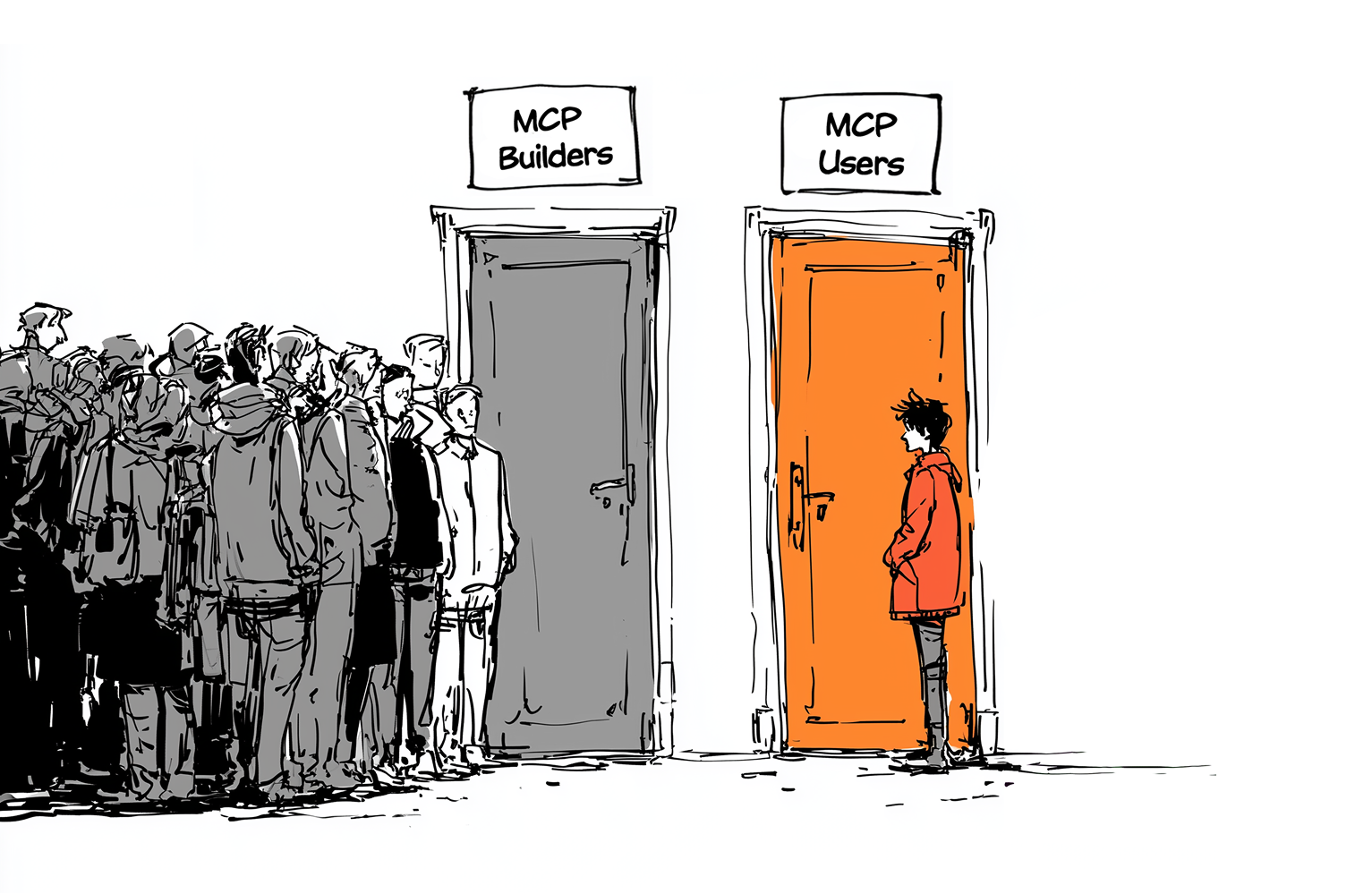
You've probably noticed all the amazing new AI that can write code, analyze data, and even make art. But underneath all that excitement is a vital piece of technology fixing the inner workings of AI systems: the Model Context Protocol (MCP).
The MCP is attractive because of how it transforms AI. The MCP is a connector between AI and services like databases and online tools like Jira and Google Docs. An MCP turns the various features and data into tools that an AI can understand and use, effectively converting AI from chatting to doing. When you bring these two together, the AI and the MCP, this is an agent (I’m simplifying).
MCPs have been adopted and hailed by devs as a wonderful and needed piece of the AI puzzle. As a result, developers using MCPs have exploded. Just look at GitHub, in the past 12 months, there have been more than 120k repos for MCPs created.
The Builders’ Paradise
To understand the importance of MCPs, consider how an AI model previously connected to the outside world. If the model needed to use a tool, say a specific travel API to check flight prices, a developer had to write a messy, fragile piece of custom software. Every minor change to the API or the AI model meant the glue code would inevitably break, forcing constant, brittle maintenance.
The MCP defines a clean, reusable way for models to connect with tools, APIs, and data, replacing this brittle glue code with standardization. It's the agreement that allows an AI model to say, "I need to check the inventory," and the inventory system to understand that request instantly, regardless of the brand of AI model or the operating system of the inventory server.
This standardization is evolutionary, which is why we’re in this intense builder-heavy phase. Developers are excited; they are experimenting, spinning up servers, and testing what's possible with this new standardized language. They are laying down the technical roads, but the traffic has yet to arrive. Real adoption is slower, and that’s completely normal when a standard shifts how systems talk to each other. The internet didn't achieve mass adoption the day TCP/IP was invented. It took off years later, once those protocols enabled user-friendly web browsers and consumer-facing applications.
The history of technology shows that adoption always follows tooling maturity. The real value of the MCP isn't any single server or an individual tool; it's that every server, every tool, and every model can potentially speak the same language. Once connecting models to real systems becomes truly frictionless, usage will scale incredibly fast. We are just waiting for the surrounding tools to mature.
However, a quick look at the most active MCP server repositories on GitHub reveals a distinct pattern that explains the low general usage: most of the current, actively developed MCPs are not built for everyday, non-technical users.
Instead, the most immediate, compelling use-cases, the "low-hanging fruit" of standardization, are highly specialized and often aimed at sophisticated power users or even outright opportunists. The popular MCPs right now cover areas like headless browser scripting (automating web interactions), IP spoofing, web scraping (automated data extraction), and complex virtual server control. Not useful to most people's daily lives.
A normal person isn't interested in a standardized protocol for running an untested web-scraping script on a remote server. They want a simple solution that says, "Find me a cheaper flight based on my calendar and loyalty points," with the click of a button. There is a massive feature gap between what developers are currently building (powerful infrastructure tools) and what consumers actually want (simple, seamless solutions).
Open System Fragmentation vs Progress
The single biggest obstacle preventing wider adoption of MCPs is a severe lack of consistency. Right now, implementations are deeply fragmented, both in their underlying approach and the resulting quality.
The situation is chaotic because nearly every major API provider has rushed to publish its own version of an MCP. Each one has a different approach, different levels of API coverage, and requires different kinds of prompting to make the AI work correctly. This lack of unity is compounded by the thousands of open-source MCPs circulating on platforms like GitHub, where quality is a complete lottery, varying from great to completely unusable, and almost all of them are universally untested in real-world, high-volume scenarios.
If a developer wants to use several MCPs, one for payments, one for user authentication, and another for a specialized AI feature, they are faced with three completely different standards. They must rewrite and adjust everything just to get them to communicate, essentially recreating the very glue code the MCP was meant to eliminate. It's like having to use a different, proprietary power plug for every single appliance in your home.
People aren't using MCPs widely because there is no easy way to bring many together with a focus on taking advantage of the amazing underlying technology.
Abstraction for the Masses
This situation is not a flaw in the technology; it's a phase in its maturation. All great tech, from the printing press to the personal computer, followed a similar path: complex invention, fragmented development, and finally, mass adoption driven by simplification and abstraction. The complexity needs to be hidden from the user.
The solution isn't to build a better single MCP, but to build a platform that abstracts the mess entirely, a system that handles the fragmentation, manages the quality control, and translates the developer’s chaos into the user’s convenience. Users don't care about protocols, they care about what gets done/ what they can do.
This is the exact problem that RUNSTACK (runstack.ai) was built to solve and why I joined.
RUNSTACK lets you create AI agents and teams of agents and then give them your daily tasks to do. It’s like having a team of personal assistants on call 24/7. RUNSTACK was built to leverage the power of MCPs for non-technical people. It serves as the user-friendly interface for the MCP ecosystem. It’s a system that codes, verifies, and standardizes high-quality MCPs, attaching them to custom agents and then letting users give them tasks.
This is the next step: moving from a developer-centric standard focused on how systems connect to a user-centric platform that dictates what amazing things those connected systems can do for people and business.